BLOG
journaling
Journaling is more than a cute trend with pretty notebooks. It can be a practical way to clear your mind, make sense of your days, and steer your life in a direction that feels more intentional. In this guide I share why and how I started journaling.
You will discover why journaling is important. You will also explore a wide range of journal styles, so you can pick a method that actually fits your personality and lifestyle.
Finally, I give you some journaling ideas for what to write about, plus realistic tips for building a habit that does not rely on motivation alone.
How To Do Journaling: The Complete Guide to Building a Lifelong Habit


ON THIS PAGE
Journaling did not start as a cute trend for me. It started at a time when my brain felt noisy and scattered, when I kept remaking plans, weekly or monthly to-do lists without any real sense of where I wanted to be over one year or five years or who I really wanted to become.
Around then I stumbled onto Ryan Holiday’s Daily Stoic YouTube channel and heard him talk about how the Stoics used journaling as a daily practice, almost like mental training and a spiritual combat.
So I tried it out. Sometimes I started my day by sitting down with my notebook before I even touched a screen as a way to prepare for the day. Totally recommend this if you need a simple action for digital detox. (Simple but not easy!) Other days I preferred to journal in the evenings, right before bedtime. To reflect on my day and be more prepared for the next day. It helps tremendously with falling asleep more quickly and peacefully.
Over time, I really felt a shift in my focus, I had more clarity about myself and my purpose and I could deal more peacefully with everyday obstacles. Everybody should try journaling, each person should make time to discover their own way.
Why Journaling Is Important
Journaling is an ancient, timeless, very powerful habit. There are enough examples from the roman emperor Marcus Aurelius, to the renaissance man Leonardo Da Vinci, to Anne Frank grounding herself in a desperate situation, to President Kennedy venting his worries about the missile crises to the author Joan Didion using her journal entries as a resource library.
They didn’t write for a future audience. In a way, their journals were like quiet conversations with themselves about what mattered, what they could control, and how they wanted to show up in the world. That idea felt the right thing to do for myself at a time in my life when I had no idea what my next steps should be.
What drew me in were the benefits people kept mentioning: more mental clarity, less emotional chaos, better focus, and a stronger sense of direction. Journaling can help you process stress, organise chaotic thoughts, observe patterns in your behaviour, and slowly transform into the person you really want to be.
Like Marcus Aurelius wrote “You have to assemble your life yourself, action by action” and a simple notebook and pen can certainly be the tools that help you climb that mountain.
Different Types of Journaling
Journaling isn’t one single thing. There are many ways to do it, and the best one is the one that feels natural to you. Some people love structure, others prefer a blank page with no rules.
I like to explore my creativity together with my writing. Maybe you do too?
Here are a few common styles, I am sure one of them will fit your personal needs and preferences well.
Daily Journal Writing
You can use a blank notebook and commit to one line a day or five minutes of writing. Some people prefer to journal with writing prompts. These are certainly an easy way to get you started.
You can also buy journal books that are prefilled with daily prompts:
The daily stoic journal has you set up for a whole year with 365 prompts for each day of the year.
Gratitude Journal
This form focuses on small moments of good in your life. Each day, list a few things that made you smile or helped you feel thankful. It might be a good meal, a kind word, or simply a moment you noticed something beautiful in nature.
Writing down even a few lines of gratitude can shift your mood and make you feel more content.
Bullet Journal
A bullet journal is a mix of planner and reflection tool where you can use lists, symbols, and quick notes to track habits, organize tasks, or plan goals.
You build your planner yourself manually according to your preferences and needs. The sheer act of writing or drawing out a calendar for example will distress and be a small daily analog antidote against too much digital screentime.
Many people turn this type of journal into a creative outlet with drawings and colors, while others keep it clean and functional.
Morning Pages
This practice comes from The Artist’s Way by Julia Cameron, a book that encourages creativity through daily writing.
The idea is to fill three pages every morning with whatever comes to mind. It’s a mental warm-up that clears your thoughts and often unlocks ideas you didn’t know were sitting under the surface in your subconscious.
Following her journal advice to the tee is a big commitment, so I advise you to tone it down to a level you can manage; for example half a page daily or three pages on a specific weekday.
Couples Journal
A couples journal is a lovely way to hold on to the moments that matter in your relationship. You can use it to write down memories, love letters, relationship check-ins and milestones as a couple.
If you want more inspiration, take a look at my couples journal ideas post. It shares some relationship journal prompts and fun and playful ideas to enjoy a journaling habit together and connect in a more intentional way.

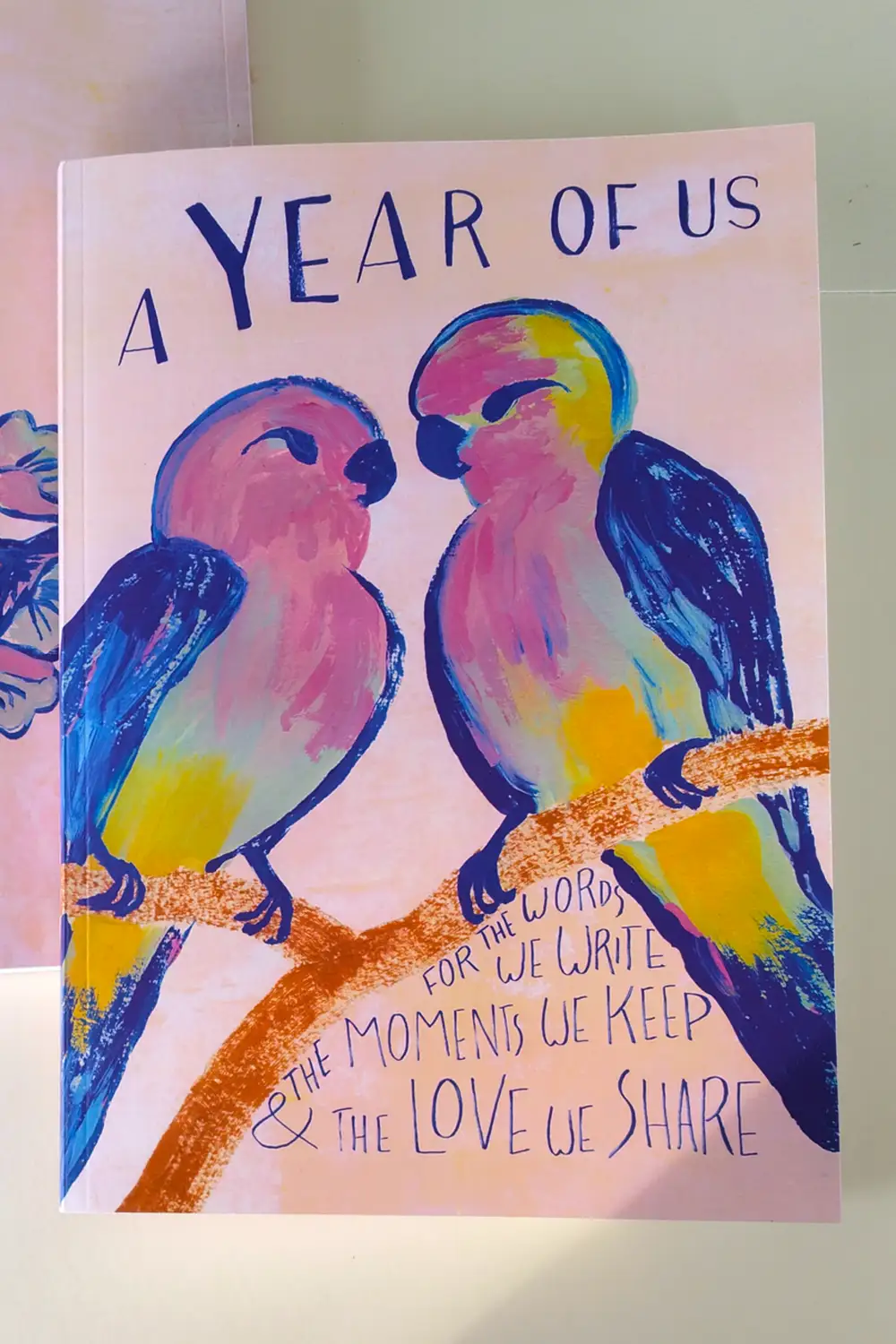
A year of us is a guided couples journal made for talking, scribbling, adding little memories.
It is designed to make the most out of couples journaling with fun relationship lists, 52 weekly writing prompts, and space for notes, photos, and keepsakes.
Idea Journal
Use this for collecting sparks of inspiration. It’s a good place to plant creative seeds you might explore later.
To keep an idea journal you need a small pocket sized blank notebook that you can carry with you. You’ll never know when an amazing idea pops up in your head. I can’t count the times I had an idea come to me unexpectedly and lost it because I didn’t write it down on the spot.
Junk Journal

This type goes beyond words. You can glue in old tickets, paint over pages, or sketch out thoughts and moods, collage surreal compositions from magazine cut-outs, build color palettes, doodle, and hand letter fun quotes.
If you want to increase your creativity you must play around and build that daily art practice in your sketchbook. Because it is low stake you express yourself more freely and find your art style or inspiration for ‘real finished’ artwork naturally. Don’t wait around for inspiration to magically appear, creativity is all about the daily workout.
Memory Book
A more personal and nostalgic version of journaling. You can combine writing with photos, greeting cards you received in the mail, travel keepsakes, or notes about special days like birthdays or Christmas celebrations. It becomes a living record of your experiences and the people who matter most.
Travel Journal
A travel journal can turn trips into living stories instead of just photos. You can jot down details from the road like the market you visited, a conversation with a stranger, a place that surprised you, a local dish you never ate before.
Add ticket stubs, sketches, or small mementos if you like. Later, when you reread those pages, the moments come back to life in a way pictures alone can’t.
Commonplace Notebook
A commonplace notebook is an ancient practice of collecting reading notes and annotations, quotes, ideas, anecdotes in one notebook.
A lot of writers use this method to explore a library of inspiration and references. But anybody can benefit from this method of keeping a personal library.
The notebook, a history of thinking on paper by Roland Allen is a good book if you want to find out more about this method.
Journal Ideas For Everyone
Writing Ideas For Your First Journal
Don’t let a blank journal page staring back at you keep you stuck because you can write about anything. Your journal is a place to explore what you feel in the moment, reflect on where you’ve been, or imagine what’s ahead. And even if this feels too overwhelming you can log an activity or doodle something. There’s no right way to do it, only the way that makes sense to you and makes you feel less stressed.
You might write about a decision that’s been circling in your mind and list the pros and cons so you can make a choice between alternatives more intentionally. .
On a rough day, use your journal as a safe space to dump anger and frustration. Paper is more patient than people; the page does not care and will not judge you. Dumping out what is in your head creates needed distance between you and your thoughts, it helps you let go of the thoughts that do not fit well and keep you stuck and overthinking.
When something wonderful happens, capture the details so you can relive them later. Over time, those entries become a timeline of your life, a reminder of your milestones and the growth you made as a person.
If you are a beginner you should make it yourself very easy and just log your activities. A logbook for food, workouts, walks, small daily goals that you accomplished,... Make it easy and get the momentum going and build from there.
Some people use journaling prompts to get started, like “What bad advice have I accepted that didn’t work out for me?”
or “What small action can I take today that will make the rest of the week easier?” Once the words begin to flow, the rest follows naturally. Discover more prompts in this article.
Eight Easy And Fun Journaling Ideas
Collect quotes and use them to start your entry more easily.
Record a meaningful dream or tarot reading.
Write a letter to someone you miss or to a part of yourself as a form of self care.
Create a list of things you want to do, see, or learn.
Fill a whole page with questions you don’t yet have answers for.
Doodle or decorate when words don’t come easily.
Hand letter fun quotes.
Make a vision board in a journal spread.

Journaling doesn’t have to be long or perfect. Some days you’ll write a single sentence; other days you might fill several pages. Both count. What matters is that your journal stays a place where you can show up as you are, and keep in touch with yourself.
Tips to Build a Journaling Habit

So you are convinced that journaling will benefit you (it will! promise) and you have decided what you want to write about, the next step is to build a routine. Not with pressure or long to-do lists but with small, consistent action.
My hack is: do not get ready to start but just start ridiculously small. Don’t stress about tools, how much you will write , how little or what type of notebook you will need. I am sure you have a notebook lying around, it doesn’t need to be completely empty or brand new. And a simple pen or pencil will do.
Choose The Right Time And Place
Pick a quiet moment that fits your day. Some people write while the house is still calm in the morning, others prefer to wind down before bed. Try both and find out if a morning preparation or an evening review fits your lifestyle best.
The place matters too. Keep your journal somewhere easy to reach, so it becomes part of the moment instead of an extra task.
Keep It Low Pressure
Your journal is not an assignment. Grammar, spelling, and length don’t matter. One sentence that feels honest is better than forced long pages. If it doesn’t feel relaxing then you are doing something wrong. Take a step back and try out different journaling styles until you find one that feels natural.
Use Tools That Help You Stay Consistent
Some people like the feel of pen and paper, others prefer apps. You can also set a reminder on your phone or keep your notebook by your pillow as a small visual cue. Whatever helps you remember will keep the routine alive.
Face The Common Obstacles
The biggest one is often time. Writing doesn’t need to take long. Start with five minutes. Skip the days you really can’t, and return the next.
A habit doesn’t need to be perfect to last. Keep in mind that the goal is to write for yourself, and explore your inner thoughts so you can grow from the insights and understand yourself better. Missing a day won’t hinder your growth as long as you pick up your journal regularly and keep the momentum going.
Let Your First Page Be Simple
The first page is the hardest one, but after that, it starts to feel like coming home.
Find a notebook.
Pick up a pen.
Write a single line.
That’s all it takes to begin.
The best time to have started journaling was a long time ago but the second best time is today!
Did you find this article helpful?
Save these on your Pinterest board for later!


By
Noor Deleersnyder
Updated on
27 January 2026
